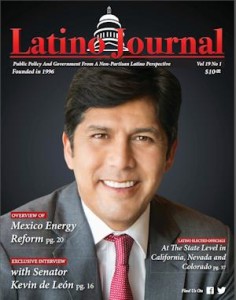
Overview of Mexico Energy Reform

Latino_Journal

Click image for article.

After excluding foreign companies for 75 years, Mexico began implementing sweeping reforms in  2013-2014 to open its energy industry and “kick-start its production of oil and gas by attracting significant outside investment.”

Attorneys Dennis R. Luna, Editor-in-Chief of the California Oil & Gas Report, and Olman Valverde, both of the Los Angeles law firm Luna & Glushon, explain the sweeping reforms implemented by Mexico in an article in the current issue of “Latino Journal.”

The article reviews the public-private partnerships that will have a major role in exploration, extraction and production, as well as refining, natural gas processing, distribution and other functions in oil, natural gas and other hydrocarbon products.

Continue reading

Mexico Holds Historic Auction of Oil Rights

Mexico held its first auction in 77 years in which foreign companies could bid on drilling rights, but oil_platformmost of the major oil companies chose to stay on the sidelines.

A consortium including Sierra Oil & Gas, a Mexican company, Houston-based Talos Energy LLC and Britain’s Premier Oil placed the winning bids on two of the 14 blocks put up for auction in the first of five phases of Round One of the auction.

Continue reading

Kern County Proposes Changes to Oil and Gas Ordinances

Kern County has released a draft Environmental Impact Report (EIR) that would change the county’s oil and gas ordinances to allow quicker review of CEQA challenges, streamline DOGGR reviews of drilling activity, and fund regional projects to improve local air quality.

Blair Knox of the California Independent Petroleum Association, noted that Kern County operates as a by-right county for oil and gas operations, one of only four California jurisdictions that do so.

Continue reading

Drought Adds Pressure To Recycle Produced Water

The four-year drought that has gripped California is adding to the pressure on oil and gas producers in the state to find ways to recycle the billions of gallons of wastewater produced from their wells.

The producers generate over 92 billion gallons of produced water, much of which is brackish and contaminated by traces of petrochemicals and chemicals used for hydraulic fracking. Most of the water is pumped back deep underground, into 50,000 disposal wells.

Continue reading

Chevron Says Recycled Water Is Clean

Chevron Corp. said that tests of the recycled oil field wastewater it sells to farmers in Kern County meets water quality standards, and does not contain contaminants an advocacy group claimed it found.

After treating it, Chevron provides 21 million gallons of the wastewater per day to the Cawelo Water District, which distributes it to 90 farms in the area for agricultural irrigation.

Continue reading

Final SB4 Regulations Issued By DOGGR

Regulations on hydraulic fracturing and other oil and gas well stimulation techniques were issued oil_wellin final form July 1 by DOGGR as required by Senate Bill 4.

The agency also certified a statewide Environmental Impact Report on well stimulation. The EIR concludes that environmental impacts of stimulation techniques can be reduced to the level of “less than significant” if mitigation measures, including use of recycled water and enhanced well cementing, are taken.

[ Click here to download the regulations. ]

Continue reading