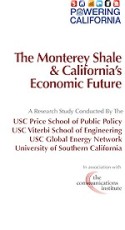
USC Study: Monterey Shale Could Mean 2.8 Million New Jobs, $200 Billion To California

USC_Shale ReportBy Dennis Luna, J.D., P.E. 

Development of the Monterey Shale could, over the next seven years, add 512,000 to 2.8 million new, high-paying jobs in California, increase income of the state’s residents by over $220 billion, and generate $24 billion in new tax revenues for state, county and local governments.

Those are the “conservative, median scenario” conclusions of a 71-page report, “The Monterey Shale & California’s Economic Future,” published by the USC Global Energy Network. The Network is a joint project of the Price School of Public Policy and the Viterbi School of Engineering, both of the University of Southern California. The Communications Institute, which supports nonpartisan analysis of public issues, collaborated on the project.

The study looked only at the economic effects of development of the Monterey Shale play. It noted that other important issues remain to be investigated by other researchers, including potential impacts on water supply, communities, air quality, greenhouse gases, seismic activity, and continued reliance on fossil fuels.

Continue reading

Unitization Promotes Oil Field Development

By Olman J. Valverde

Oil and gas resources often lie under many different parcels of land, with different owners, especially in urban areas. What happens when the owners of most of the property in an oil field want to proceed with exploiting those resources, but a few holdouts object?

In California and many other states, there is a way to overcome this problem. It is a legal procedure called “unitization.” Essentially it allows minerals to be accessed under all of the property, including that owned by the non-consenting landowners, by obtaining approval from the State Supervisor of Oil and Gas.

The procedure, including the steps that must be followed in California, is outlined in an article by Olman J. Valverde, an attorney with Luna & Glushon specializing in oil and gas issues. The article is posted here.

Revival of Whittier Oil Field Is Focus of Lawsuit

 By Dennis Luna, J.D., P.E.

A Los Angeles Superior Court judge may soon determine whether the City of Whittier will receive up to $100 million per year from the proposed return to production of a century-old oil field. The potential income is nearly twice the Southern California community’s $55 million annual budget.

Environmentalists and some Los Angeles County officials oppose plans by the city to allow Matrix Oil Co. of Santa Barbara to drill on seven acres of a 1,600 acre wilderness preserve in Whittier. They obtained a temporary restraining order from the Los Angeles Superior Court, halting exploratory drilling. A hearing on the case is scheduled for February 21.

Continue reading

California Seen As Next Shale Boom State

By Dennis Luna, J.D., P.E.

California’s huge and largely untapped Monterey shale oil field gives the state the potential to become a much larger producer and exporter of oil and gas, creating up to $1 trillion in new business and social benefits, and restoring the state government’s fiscal health.

That’s the conclusion of Mark P. Mills, in a column published in the January 16, 2013, issue of the Wall Street Journal.

Mills is a senior fellow at the Manhattan Institute, an economic think tank. He is also founder and CEO of the Digital Power Group, an energy- and technology-focused investment advisory firm, and he writes the Energy Intelligence column for Forbes.

The Monterey shale field, which extends 200 miles from Bakersfield into central California, contains “Saudi Arabia-scale oil resources,” Mills wrote in the Journal column. Newer techniques including horizontal drilling and hydraulic fracturing make recovery of that resource both possible and environmentally clean. Continue reading

An Analysis of DOGGR’s Draft Fracking Regulations

By Mike Flores & Olman J. Valverde, Esq.
Law Offices of Luna & Glushon

The Division of Oil, Gas, and Geothermal Resources (“DOGGR”) on December 18, 2012, released a highly anticipated “discussion draft” of regulations that pertain to DOGGR’s oversight of hydraulic fracturing in California.

This article looks at the background of this action by DOGGR, the content of the draft, and initial reactions both by opponents of fracking and by members of the oil and gas industry.

Continue reading

DOGGR Issues ‘Discussion Draft’ of Fracking Regs

By Dennis Luna

DOGGR, the Division of Oil, Gas, and Geothermal Resources of California’s Department of Conservation, on December 18th released a “discussion draft” of regulations for hydraulic fracturing, or “fracking”.

The discussion draft does not actually start the formal rulemaking process. It is intended to be a starting point for discussion by key stakeholders – industry, the environmental community, the general public and other regulatory officials. All this is in preparation for the formal process, which probably will begin in early 2013.

The “discussion draft” regulations include provisions for testing of wells before fracking begins; advance notification of planned fracking activity; monitoring of wells during and after fracking operations; disclosure of the materials used in fracking fluids; storage and handling of hydraulic fracturing fluids; and ways to balance the public’s desire for information with industry’s need to protect trade secrets.

Information about the process is on the DOGGR Home Page.  The agency also has a page of information about hydraulic fracturing in California.

Documents issued by DOGGR to accompany the announcement include:

Printer-Friendly Copy