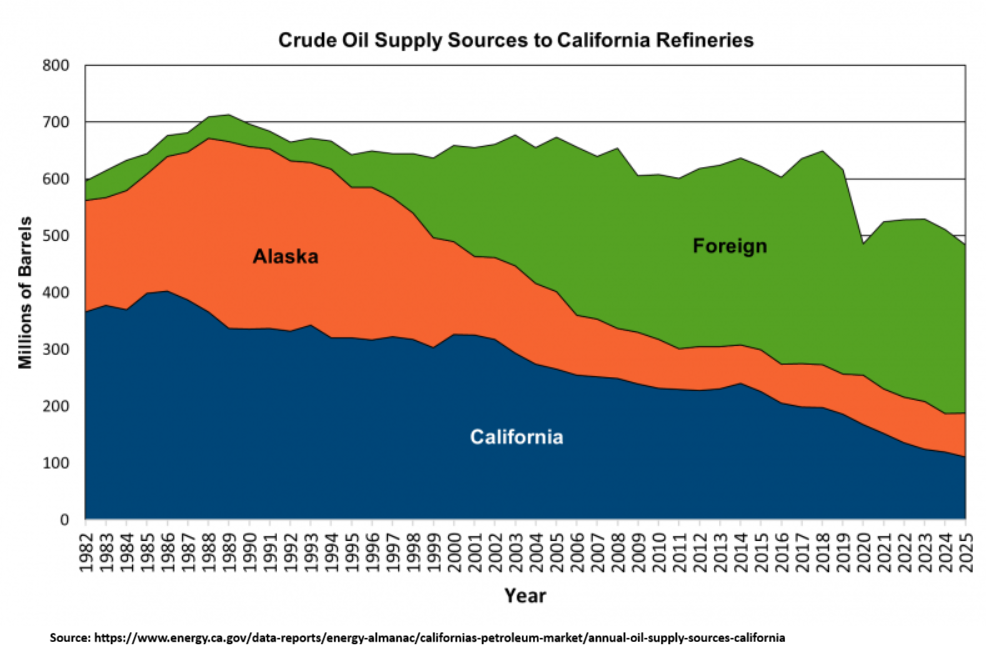
California has become heavily reliant on foreign oil, not because our overall use of petroleum disappeared, but because state policy made producing and processing local crude progressively harder and more expensive. The data tell the story: in 1985, 61.8% of the crude run in California refineries was produced in‑state and just 5.5% came from foreign sources. By 2025, in‑state production supplied only 22.9% of refinery feedstock, while foreign oil had jumped to 61.1% of the barrels processed in California refineries.
Consumers did not ask for this. Rather, over several decades, Sacramento layered climate and anti‑fossil‑fuel measures on top of traditional environmental regulation, then added extraction‑specific rules—offshore leasing bans, a phase‑out of fracking, and an announced end‑date for in‑state extraction. These policies were explicitly designed to constrain and ultimately stop local crude production, raising regulatory risk and compliance costs for California producers and discouraging reinvestment in fields and refineries. As local supply fell, refineries increasingly turned to tankers bringing in foreign crude to keep meeting demand.
As a result, California’s energy security has been weakened, and the state is increasingly exposed to disruptions and price shocks driven by global turmoil.